






Opening a Spanish Bank Account to Buy Property in Costa Blanca: A Practical Guide for EU Buyers
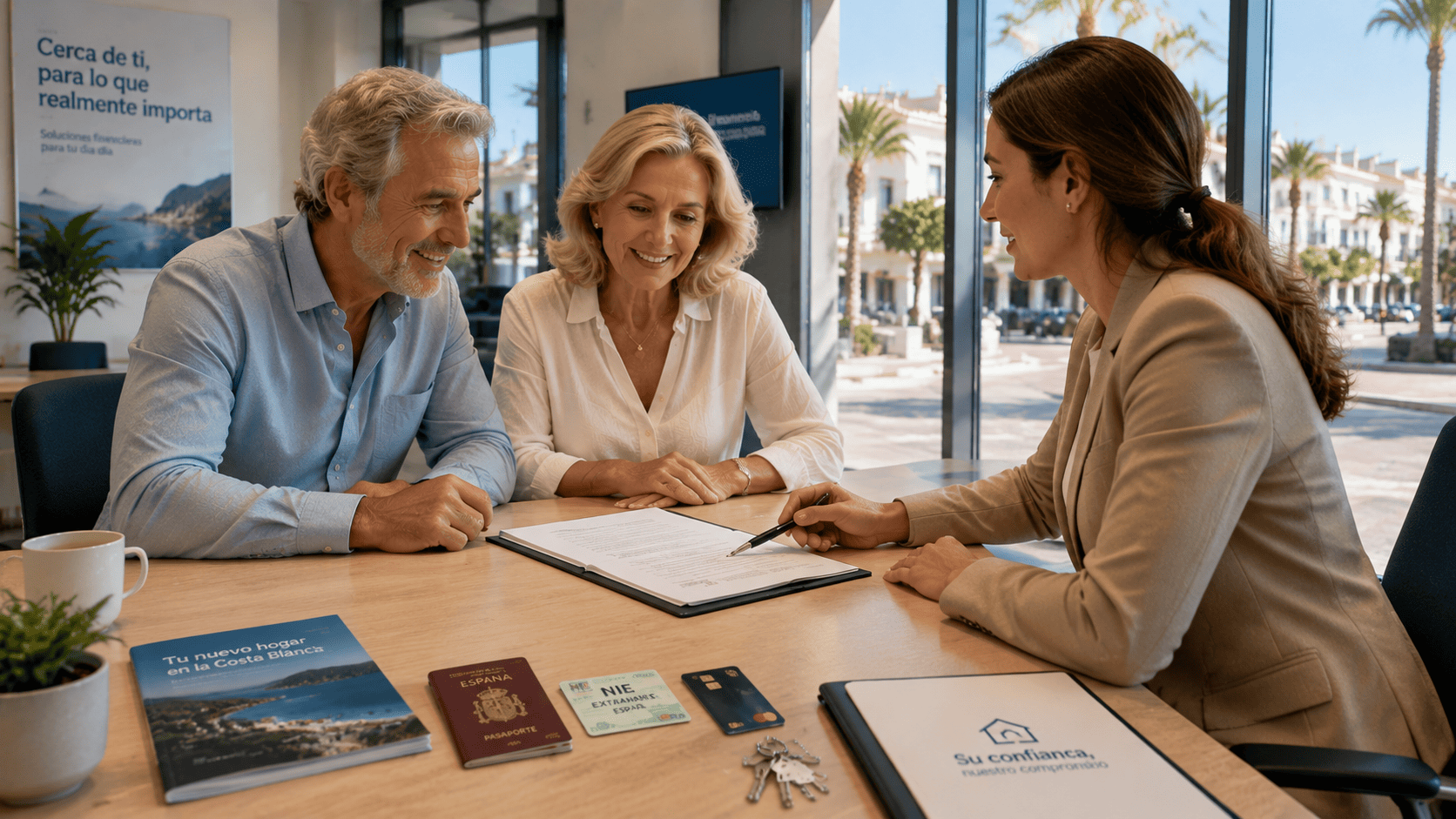
You've found the property. Your offer's been accepted. Then your lawyer asks: "Have you opened a Spanish bank account yet?"
It's a question that catches a lot of EU buyers off guard, especially those planning ahead for retirement, where the whole point of buying in Spain is to simplify life, not add another bureaucratic hurdle. Opening a bank account isn't the exciting part of buying a home, but getting the timing and paperwork right can be the difference between a smooth completion and a stressful, delayed one.
In this guide, we'll cover when to open a Spanish bank account, what documents you'll need (including what's different if your income comes from a pension rather than a salary), how to choose the right bank, and the mistakes that most often slow purchases down. Along the way, we'll share what we've actually seen work (and not work) for the international buyers we've helped find homes in Costa Blanca.
Do You Need a Spanish Bank Account to Buy Property?
Short answer: in most cases, yes, though it's not always a strict legal requirement.
Spanish law doesn't force EU buyers to hold a Spanish account to complete a purchase. In theory, you could transfer funds directly from your home account. In practice, such an account makes everything after completion far easier:
Paying your reservation deposit and completion balance
Setting up direct debits for utilities and community fees
Paying annual property taxes such as IBI (the local property tax, set by your town hall — worth checking the exact rate for your specific municipality, as it varies across Costa Blanca)
Managing ongoing costs if you're not living in Spain full-time, or receiving a pension from abroad each month
For pension-funded purchases specifically, having a Spanish account also makes it much simpler to receive regular pension payments locally, rather than paying currency conversion fees on every transfer from your home account.
NIE Number vs. Bank Account: What You Actually Need First
This is where most buyers get confused, so let's clear it up early.
Your NIE (Número de Identidad de Extranjero) is your Spanish foreigner identification number. It's issued by the Spanish Ministry of the Interior and you'll need it for almost every part of buying property here: signing contracts, paying taxes, and yes, opening most types of bank accounts. Having an NIE does not make you a Spanish resident; the two are separate things entirely, which trips up a lot of buyers who assume getting one means the other is settled.
In short: you'll typically need to apply for your NIE before you can open a standard Spanish bank account tied to a property purchase. Your lawyer can usually help you apply for both in parallel so neither one holds up the other.
When Should You Open Your Account?
The ideal window is after your offer is accepted, but before completion.
There's no need to open an account before you've even started viewing properties. Many buyers assume they should, and end up doing it too early with no clear purpose. Once your offer is in, opening the account gives you time to:
Transfer funds securely ahead of completion
Set up direct debits for taxes, utilities, and community fees
Resolve any extra document requests from the bank without holding up the sale
If you're travelling to Costa Blanca for a viewing trip and think you might buy during that visit, it's worth building in time for a branch appointment. It can save you a second trip and keeps the process moving once your offer is accepted.
Choosing the Right Bank in Costa Blanca
The best bank isn't necessarily the one with the lowest fees, but the one that makes your purchase straightforward.
What to compare:
Experience with international and retired clients. Branches in areas like Jávea, Moraira, Altea, and Orihuela Costa handle far more non-resident and pension-income applications than branches elsewhere, so they tend to move faster and ask fewer repeat questions.
English-speaking staff. If Spanish isn't your first language, being able to discuss your finances clearly matters more than people expect, especially for anything involving tax or pension documentation.
In-branch service, not just an app. Online banking is convenient, but if you're managing a pension transfer or a large one-off payment, having a real person at a branch you can sit down with is often more reassuring — and sometimes necessary, since larger transfers can trigger manual checks that are easier to resolve face to face.
International transfer terms. Ask specifically how the bank handles regular incoming pension payments from abroad, not just one-off transfers — the fee structure is often different.
Mortgage options, if relevant, compared alongside everyday account terms.
Which Banks Do EU Retirees in Costa Blanca Typically Use?
There's no single "best" bank — the right choice depends on how much you value English-language support and branch access versus lower fees. That said, a handful of banks come up consistently among EU retirees and other foreign buyers in this region:
Bank | Known for | Worth knowing |
Strong presence across Alicante and the Costa Blanca; English-language branch support and online banking; a dedicated non-resident "Key Account" for people managing money in Spain without living here full-time | Often the first recommendation for English-speaking retirees due to its documentation flexibility | |
Spain's largest branch network; international client desks used to handling foreign income, including pensions and different residency/visa situations | More branches locally, but service style varies more between individual branches | |
Extensive branch network and genuine global reach, useful if you already bank with Santander in your home country | English support exists but is less consistent branch-to-branch than Sabadell | |
A strong, well-designed mobile app | A solid option if you're comfortable managing most banking digitally | |
Lower fees, primarily online | Convenient for remote account management, but less suited if you'd prefer face-to-face support for a pension-funded purchase |
A few practical notes for retirees specifically:
Branch experience varies more than the bank's brand. Two branches of the same bank in different towns can handle a pension-income application very differently — this is exactly why calling ahead and asking your lawyer or agent for a specific branch recommendation matters more than the name over the door.
Some buyers hold two accounts — one at a bank with a large branch network for everyday admin (bills, taxes, community fees), and one at a bank known for English support for anything requiring more detailed conversation, like the initial purchase transfer.
Digital-only options (Wise, N26, Revolut) can be useful for cheap currency transfers, but most buyers still open a mainstream Spanish account alongside them, since not all are set up to handle property-related transactions or larger source-of-funds checks in the same way.
Bank fees, English-language support, and specific account products change fairly often, so it's worth confirming current terms directly with the branch before deciding — this isn't financial advice, just a starting point for your own comparison.
Documents You'll Need for Your Bank Account
Requirements vary slightly by bank and branch, so it's worth calling ahead, but here's what most EU buyers should prepare:
Buyer profile | Documents you may be asked for |
Employed | Passport/ID, NIE, proof of address, recent payslips or employment contract |
Self-employed | Passport/ID, NIE, proof of address, recent tax return or business accounts |
Retired | Passport/ID, NIE, proof of address, recent pension statements or proof of pension income |
Buying your retirement home? If your income comes from a state or private pension, Spanish banks will usually ask for evidence of your pension instead of employment income. As requirements vary between banks, it's worth confirming exactly what documents you'll need before your appointment.
Spanish banks are legally required to verify identity and understand the origin of funds for larger transactions, in line with national anti-money laundering regulations overseen by the Banco de España. This is standard practice, not a red flag on your application, but it does mean extra paperwork can appear at short notice, so it's worth building in buffer time.
Opening a bank account is only one part of the paperwork involved in buying a home in Spain. If you're preparing for your purchase, we also recommend reading our guide to the key documents you'll need to buy property in Costa Blanca, which explains the role of the NIE, passport, proof of funds and other essential paperwork before completion.
What We've Learned Helping Buyers in Costa Blanca
A few things that consistently make the difference for the buyers we work with:
1. Banking works best as part of the buying timeline, not a separate task. Buyers who organise their account alongside the legal checks and fund transfers (rather than treating it as an afterthought) have a noticeably smoother completion.
2. For retirees specifically, the in-person relationship matters more than the app. Buyers managing a pension income tend to prefer, and often need, a branch where staff already understand how pension transfers and translated documents work — it avoids having to explain your situation from scratch.
3. Ask about account purpose, not just fees, before signing. Whether the account is meant to manage a holiday home you'll visit twice a year, or a permanent residence funded by a monthly pension, changes what "the right account" actually looks like.
FAQs
1. Can I use my existing EU bank account to buy property in Costa Blanca?
In some cases, yes. Most buyers still open a Spanish account to simplify the purchase and manage ongoing costs like utilities, community fees, and IBI.
2. Can I open a Spanish bank account before moving to Spain?
Yes. Many banks offer non-resident accounts to EU citizens, though the exact documents required vary. If you're on a viewing trip, opening the account during that visit can save time later.
3. How long does it take to open a Spanish bank account?
With all documents ready, some banks can open an account within days. Additional identity or source-of-funds checks (more common for larger, pension-funded transactions) can extend this, so avoid leaving it until completion week.
4. Do I need an NIE to open a Spanish bank account?
In most cases, yes, for a standard account linked to a property purchase.
5. Can I open a Spanish bank account if my only income is a pension?
Yes. Many EU retirees open Spanish bank accounts when buying property in Costa Blanca. Instead of payslips, you'll typically be asked to provide documents confirming your pension income, alongside your identification and other standard paperwork. As each bank has its own onboarding requirements, it's always worth checking with the branch before your appointment.
6. Can I pay for my Spanish property purchase directly from my pension income?
Yes, but be prepared to show pension statements or an award letter as proof of the source of funds, rather than a payslip — and to budget for currency conversion if your pension is paid in a different currency.
7. Which bank is best for EU retirees buying property in Costa Blanca?
There's no single best option, but Banco Sabadell and CaixaBank are the two most commonly used by English-speaking retirees in this region, largely due to English-language support and experience handling pension income. The right choice ultimately depends on your priorities (branch access, digital banking, or lower fees) so it's worth comparing current terms directly with a couple of local branches.
8. Can two people share the same Spanish bank account?
Yes. Most banks allow joint accounts for buyers purchasing together, which simplifies managing shared payments and household costs.
Buying Property in Costa Blanca? E-Style Spain Can Help
Opening a Spanish bank account is one step in buying a home here. But getting the timing right makes the rest of the process noticeably smoother.
At E-Style Spain, we help international buyers, including those planning their retirement, through every stage of the purchase, from finding the right property to connecting you with local lawyers, banks, and other professionals who are used to working with pension income and foreign documentation. We don't open accounts on your behalf, but we'll tell you exactly when to arrange one, what to prepare, and how it fits into your specific purchase timeline.
Ready to talk it through? Book a free 15-minute call with our team, or download our property purchase checklist to see exactly what to prepare before you start. No obligation.
Whether you're looking for a beachfront apartment, a modern villa, or a retirement home under the Costa Blanca sun, our local team is here to help you buy with confidence.
Share